Mostrando entradas con la etiqueta Experiences. Mostrar todas las entradas

What to do with an umbrela at the Desert of Kutch


 ( Foto: Harry Fisch )

NEW BLOG ADDRESS  WWW.NOMADPHOTOEXPEDITIONS.COM

 Un viaje fotográfico al Kutch. 

A photographic journey to Kutch.
How to use a photographic umbrella in the desert


Dhanraj Malik Prince, son of King Malek Shri Mahomed Mahomed Shabbirkhanji Azizkhanji is a real personality in his region.  He owns a camp as well as an orphanage. He resolves  disputes between his subjetcs. Next to him, , holding an umbrella, a worker of the salt pans.

We are in the
desert of Kutch, India. Near Pakistan.

Dhandrash Malik, "Bapu" or "Excellence" for the rest of us, is the current owner of the camp. Although legally his title is depreciated, in practice he still reigns as prince of a "state" of 78 km2 and enjoys the sovereignty over 7 villages. The locals and Rabaris (nomadic tribes) are still asking him to act as
  the judge, settling disputes instead of submitting the cases to official institutions.

Me preguntaba un amigo qué es lo que hace ese señor, con un paraguas blanco y brillante, en medio del desierto.
Evidentemente, le contesté, hace el indio.
Pero no un indio cualquiera.

El príncipe Dhanraj Malik, hijo del rey Malek Shri Mahomed Shabbirkhanji  Mahomed  Azizkhanji, es una auténtica personalidad en su región.  Mantiene uno de los  campamentos  al que vamos en los viajes fotográficos de Nomad Expediciones Fotográficas y, además,  un orfanato. Dirime disputas.Junto a el, sosteniendo el paraguas,  un trabajador de las salinas.


I was privileged to attend a hearing, under the veranda. Seated, facing the lake -  he owns a beautiful lake in the small town of Zainabad - sipping chai (tea) while quietly chatting  in English. Two feet away, on my  left, squatting on the floor and playing with the sand, an elderly couple of Rabaris was waiting silently. They stood for  more than 45 minutes in the same place. We chatted about trifles.

 - Bapu ("Excellence") , I asked the prince , what are these people doing ?
       

- Waiting, he states without changing the gesture, staring into space.       
 - And what do they wait for? , did I say almost whispering not to be too rough.

No response. Bapu looks distracted at the lake. His answer takes
 an eternity.      


- A talk with me, answered Bapu. - Silence and another sip.      

- How long will they have to wait for ?      
-  As much as needed ... If they want me to take care of their  problem. -

Time goes on
  and slowly, the prince decides, more as of courtesy to me that as deference to his subjects, to deal with the matter.  He politely asks my permission and starts his work. The old lady looks about eighty, impeccably dressed as Rabari . Her husband of the same age, entirely dressed in white. Finally, the hearing ends after ten minutes. The couple leaves respectfully.

Estamos en el desierto  del Kutch, India. Cerca de Pakistán.Dhandrash Malik, "Bapu" o "Excelencia" para el resto de los mortales, es el actual propietario del campemento.  A tesar de$que, legalmente, su título estǡ en dewuso, en$la prágtica sigue ejergiendo como príncipe de$un "Estado" de 78 km2 y con soberanía sobre 7 pueblos.  Los habitantes de la zona y los  Rabarís (tribus nómadas)  siguen acudiendo a el para que juzgue las disputas  en lugar de dirigirse a las autoridades judiciales oficiales.

Fotografía personal

Personal Photography


You stand there and... “bang”, shoot, just if it was  a building, a dog, a tree.

You can always take pictures with your
200 mm lens, being really far away and capture expressions for your album. But you will  miss the soul. And the image will be no more than a butterfly stuck with a pin in your little box, a trophy, the memory of a place, not a person. Nothing if you compare it  to the  image  forever linked to a personal relationship.


Te plantas delante y, sin más,  ¡zas!, disparas, como si fuera un edificio, un perro, un árbol.

Siempre  puedes hacer fotos con un 200 mm desde lejos, muy lejos y captar expresiones para pegarlas  al  album. Pero le faltará el alma. Y la  imagen no será más que una   mariposa clavada con un alfiler en tu  cajita, un trofeo, el  recuerdo de un lugar, no de una persona. Nada que ver con lo que te aporta el  instante eternamente congelado unido al de una relación personal .
  
Fotografía Harry Fisch

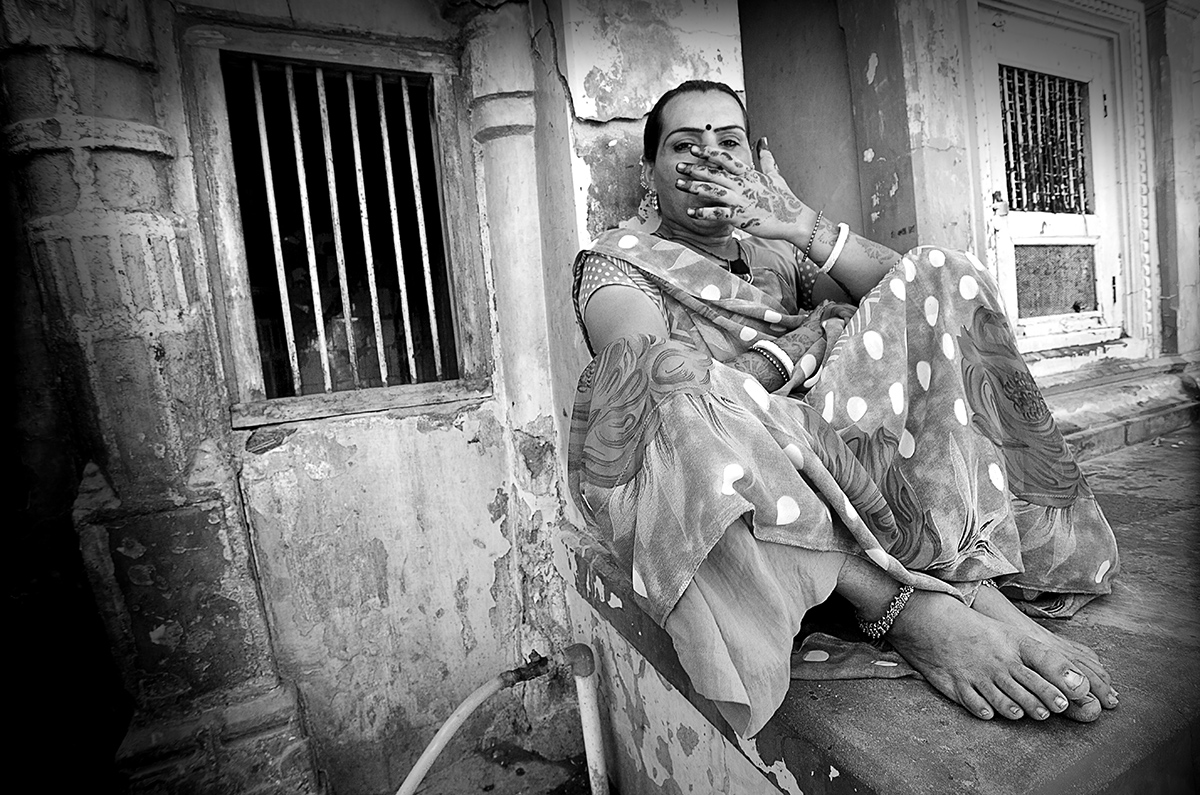
Hijra (Maasi en el Gujarat) en un templo. para saber más http://es.wikipedia.org/wiki/Hijra


Photography of people - let's call it “personal photography” – changes with a “relational” approach, trying to shorten the distance, sometimes more apparent than real, between photographer and photographed.

On our Nomad Photographic Expeditions we have developed  a vocation for stories and situations were we have people  participating in the images. I am surprised by the way photographers and  travelers address travel photography, turning people into objects rather than treating them respectfully, as subjects of the photographs.

On countless occasions I have been told  about  unfriendly or aggressive people facing cameras. Honestly my experience is totally different.The camera can be the door to a relationship if not the culmination of it. In remote areas, cities where cultural distance is large relative to my world and language I count on human curiosity. Many times  the villager is as curious about my life as I am about his.


La  fotografía de personas - llamémosle fotografía personal -  gana mucho, yo diria todo, con un abordaje relacional, intentando acortar la distancia, más aparente en ocasiones que real, que media entre el fotógrafo y fotografiado. 

En mis  expediciones  fotográficas  desarrollamos   una vocación de fotografía de historias y situaciones casi siempre contando con la inclusión, participación diria yo más, de personas en  las imágenes.   Sorprende ver la forma en la que   la mayoría de turistas aborda la fotografía humana en los viajes.  Cosifican a las personas transformándolas en objetos en lugar de tratarlas respetuosamente, como sujetos de las fotografías. 

Un Brahmin de Karnatka, realizando sus rezos matinales

A Brahmin from Karnatka, doing his morning prayers at Benares. by Harry Fisch
Un Brahmin de Karnatka realizando sus rezos matinales (foto:Harry Fisch)
ESTE BLOG ESTÁ INACTIVO. 
POR FAVOR TOMAD NOTA DE LA NUEVA DIRECCION DEL BLOG

http://www.nomadexpediciones.com/blog


I sat with camera on a step next to Dasaswamedh Ghat. Early in the morning. One of my daily walks.

On the foreground a Brahmin - I later got to know that he was coming from Karnataka - was doing his morning prayers. While I was taking my pictures a man in red approached and warned me: " When I will be praying ,don't take pictures". I nodded and kept with my pictures. To my surprise, five minutes later another man -dressed in white- came to me:


- "Who are you taking in your pictures", he asked.

- "The man on the foreground "
- "!Well, he is my father"
- I showed the LCD from my camera, "Oh, I am being quite respectful", I said.

We started talking. I finally met the Brahmin, through his son, a bright young Civil Engineer on pilgrimage to Varanasi . Father and son were dressed in a very traditional way, only for their prayers....


I had later the opportunity to meet the rest of the family we shared pictures. They wanted to have the picture of a Spanish tourist with them in Benares..


Here following a very good description of Benares by Smithsonian Magazine:


"At six in the morning, the alleys of old Varanasi gleam with last night's rain. One path just wide enough for two men to walk abreast leads past shops down to the holy river Ganges. It's barely sunrise, but the alleys are already in chaos. Men jostle women, women jostle fat bullocks, bullocks narrowly avoid stepping on children. Everything is for sale – small bottles of holy Ganges water, larger bottles of branded mineral water, tiny figurines of the Lord Shiva, whose town this is. Tourists, almost invariably wearing colourful harem pants, brush shoulders with locals."

Read more: www.smithsonianmag.com/travel/The-Holy-City-of-Varanasi.h...

Minas de sal

Salt pan worker, Gujarat. by Harry Fisch

ESTE BLOG ESTÁ INACTIVO. 
POR FAVOR TOMAD NOTA DE LA NUEVA DIRECCION DEL BLOG

http://www.nomadexpediciones.com/blog

Salt pan worker, Gujarat., 
 
India es el tercer mayor productor de sal después de China y EE.UU y cerca del 70 por ciento de los 19-20 millones de toneladas que produce anualmente proviene del estado occidental de Gujarat. En el pequeño Rann de Kutch, un estéril desierto y  centro local de producción de sal, unas 200.000 personas trabajan descalzos bajo dificultades extremas, expuestos a un sol implacable .
La mayoría de los trabajadores de las salinas empiezan muy jóvenes, a los  ocho años y mueren jóvenes. Tareas bajo temperaturas extremas, que pueden llegar a 52º con la reverberación de la sal y  sin equipo de protección contra las altas temperaturas  hacen que muchos sufran ceguera y daños en la piel. Las partes del cuerpo expuestas son cubiertas por una capa abrasiva de sal, reduciendo drásticamente su esperanza de vida. 

La serie completa aquí
 ------------------------------------
India is the world's third-biggest producer of salt after China and the US, government figures show, and about 70 percent of the 19-20 million tonnes it produces annually comes from the western state of Gujarat.In Little Rann of Kutch, a barren brown desert and local centre of inland salt production, an estimated 200,000 people work barefoot in extreme hardship, exposed to a relentless sun and a host of occupational dangers.

 Look at the series here
 

Familia trás el té. Zainabad.


Familly after the tea. Zainabad., a photo by Harry Fisch. 


 Este año volví a Zainabad con las fotos que había hecho el año pasado. Kanu me invitó a tomar el té en su casa. En menos de quince minutos, el te en la intimidad, sentado en el suelo,  se convirtió en una celebración familiar. Un Rabari que fotografié el año pasado vino con sus hijos. Kanu trajo a su hija para la foto  mientras que su mujer se puso frente al hermano de Kanu. El niño tuerto es sobrino de aquél. Totamente cubierta, sonriente bajo el velo, la abuela...

I came back to Zainabad with some pictures taken last year. This made a difference...  
Got an invitation for  tea at Kanu's home. A surprising experience.
In less than fifteen minutes It grew from a tea, seating on the floor,  with  his wife, into a familly meeting.  A  Rabari that I pictured last year (on the left) came with his son and daughter. Kanu (with a shirt in the center of the picture) with his daughter. His wife is standing in the darkness at his left side and his brother, on his right, behind him. The one-eyed boy on the right is Kanu's brother son. The fully covered woman, behind him, the grand mother.
Three generations...